
Introduction
3D printing has already revolutionized industries like healthcare, automotive, and aerospace. But can it make the same impact in construction, particularly in India? With rapid urbanization, rising infrastructure demands, and labor shortages, 3D printing offers a potential solution for faster, cost-effective, and sustainable building methods.
At Panjetani Buildwell, we see emerging technologies like 3D printing complementing traditional solutions such as PEB structures and PUF panels to optimize industrial construction.
What is 3D Printing in Construction?
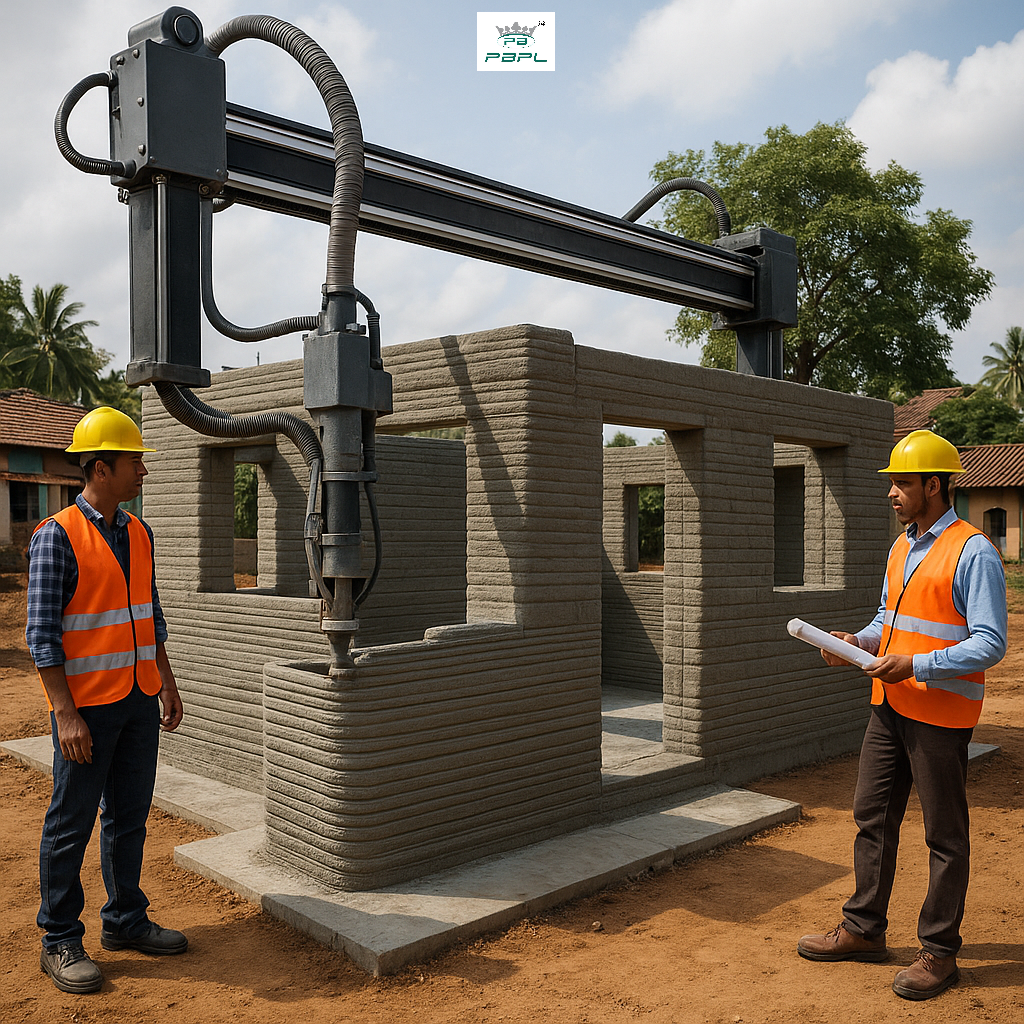
3D printing in construction, also called additive manufacturing, involves creating building components or entire structures layer by layer using materials such as concrete, polymers, or composites. Unlike traditional construction methods, which rely heavily on labor and sequential processes, 3D printing allows precision, customization, and minimal waste.
Key technologies include:
- Concrete Extrusion: Layer-by-layer extrusion of cementitious material.
- Binder Jetting: Binding powders with adhesives to create structural elements.
- Robotic Arm Printing: Automated construction of walls, panels, and modular units.
For a deeper understanding of modern construction technology, refer to Construction World.
Opportunities for India
- Speed and Efficiency: 3D printing can drastically reduce construction timelines, making it ideal for urban housing, industrial warehouses, and infrastructure projects.
- Cost Reduction: Lower labor requirements and less material waste can make projects more economical.
- Customization: Enables architects and engineers to create complex, tailored designs without increasing costs.
- Sustainability: Minimal waste, use of recycled materials, and energy-efficient processes make 3D printing a green alternative.
- Affordable Housing: Rapid, low-cost housing solutions could address India’s urban housing shortage.
Read more about India’s infrastructure growth in NITI Aayog’s Infrastructure Outlook.
Challenges in the Indian Context
- High Initial Investment: 3D printers and technology setup can be expensive.
- Material Limitations: Currently, only certain types of concrete and composites are compatible with large-scale 3D printing.
- Skilled Workforce Shortage: Operating and maintaining 3D printing equipment requires trained professionals.
- Regulatory and Standardization Issues: Building codes in India are still evolving to accommodate 3D printed structures.
- Infrastructure Readiness: Integrating 3D printing with existing construction workflows requires planning and coordination.
Current Examples in India
- Mysuru 3D Printed House Project: An affordable housing project in Karnataka used concrete 3D printing for wall panels.
- Surat’s 3D Printing Experiments: Several commercial offices and modular structures are being tested with 3D printed components.
- Startup Innovation: Indian startups are exploring smaller-scale applications such as 3D printed wall panels, facades, and modular designs.
For international trends, see World Economic Forum on 3D Printed Buildings.
The Future Outlook
While 3D printing in construction is still in its early stages in India, the potential is enormous. With government support for smart cities, affordable housing schemes, and innovation in industrial construction, 3D printing could transform urban landscapes in the next 5–10 years.
Key requirements for success:
- Investment in technology and training
- Updated building codes and standardization
- Collaboration between startups, construction firms, and academia
If India overcomes these challenges, 3D printing could shift from being a futuristic dream to a mainstream construction reality.
Conclusion
3D printing in construction offers a blend of speed, efficiency, and sustainability, making it a promising solution for India’s growing infrastructure needs. While challenges remain, ongoing innovation and pilot projects suggest that the dream of 3D printed buildings is steadily becoming a reality.
For modern construction solutions today, explore Panjetani Buildwell’s PEB structures and PUF panels for faster, durable, and energy-efficient industrial projects.