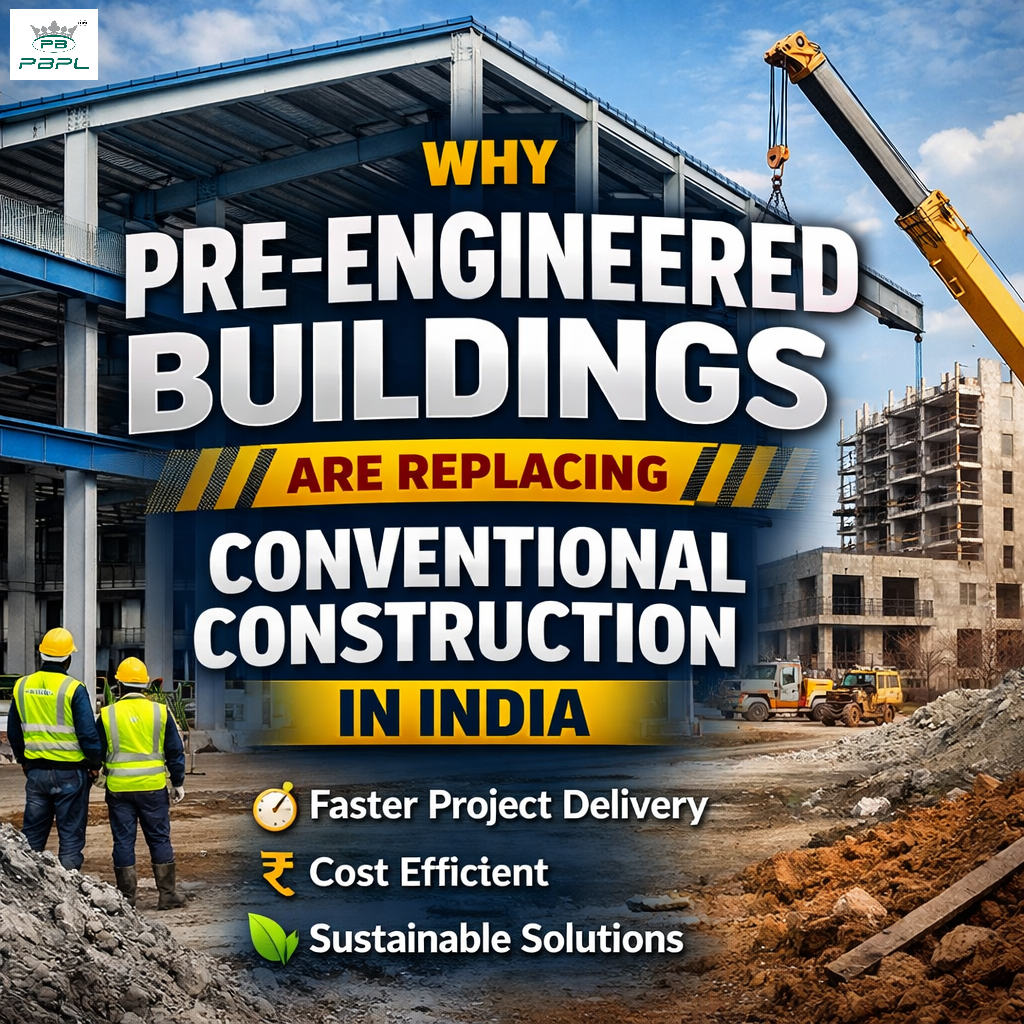

Why India’s Conventional Construction Is Being Replaced by Pre-Engineered Buildings
The building sector in India is changing dramatically, Pre-Engineered Buildings (PEBs) are quickly displacing traditional building techniques in the commercial, industrial, and warehousing sectors due to the growing demand for quicker project delivery, cost effectiveness, and sustainable solutions.
However, what precisely is causing this change? Let’s examine the reasons for PEBs’ rise to prominence in Indian construction.
What Are Pre-Engineered Buildings in India?
Steel structures that are designed, built, and installed at the project site under factory control are known as pre-engineered buildings. PEBs prioritize speed, optimal material utilization, and precision engineering in contrast to traditional RCC construction.
They are therefore perfect for:
- Sheds used for industry
• Storage facilities Manufacturing facilities
• Parks for logistics
• Structures with a large span
👉 Find out more about our Pre-Engineered Building Solutions (click here)
Why Pre-Engineered Buildings Are Replacing Conventional Construction
1. Faster Project Delivery with PEB Construction
In construction, time equals money. Because PEB projects involve concurrent design, manufacture, and site preparation procedures, they can be finished 30–50% faster than traditional approaches.
For industries hoping to get up and running fast, this speed is essential.
2. Cost Benefits of Pre-Engineered Steel Buildings
PEBs lower project costs overall by:
- Enhanced use of steel
• Less labor is needed
• Minimal waste of materials - Reduced foundation expenses
PEBs provide more budget control and cost predictability than conventional RCC construction.
3. Design Flexibility & Scalability
Clear spans, more column-free spaces, and simple future expansion are all made possible by PEBs. They are very well suited for contemporary industrial needs because of their adaptability.
PUF panels can also be incorporated for energy efficiency and thermal insulation.
👉 Check out our PUF Panel Solutions (Internal Link).
4. Superior Quality & Precision
Because parts are produced under carefully regulated factory conditions, PEBs provide:
- Reliability in quality
- Excellent structural precision
- Improved safety regulations
It is challenging to accomplish this degree of accuracy with traditional on-site construction.
5. Sustainability & Eco-Friendly Construction
PEBs encourage environmentally friendly building techniques by:
- Cutting down on building waste
• Making use of recyclable steel
• Reducing pollutants on-site
Steel-based building is essential to the development of sustainable infrastructure, according to industry insights provided by the Steel building Association of India.
PEB vs Conventional Construction: A Quick Comparison
| Parameter | Pre-Engineered Buildings | Conventional Construction |
| Speed | Very Fast | Slow |
| Cost Control | High | Moderate |
| Design Flexibility | Excellent | Limited |
| Maintenance | Low | High |
| Sustainability | High | Moderate |
Why Indian Industries Are Choosing PEBs
With quick expansion in:
- Warehousing & logistics
- Manufacturing & MSMEs
- Industrial parks
- Export-oriented units
PEBs offer a construction option that is ready for the future and supports India’s “Make in India” initiative and infrastructure expansion.
👉 Visit our internal link to view our turnkey industrial construction services.
Conclusion
In India, pre-engineered buildings are becoming the new norm for commercial and industrial construction; they are no longer an option. PEBs are a better option than traditional construction techniques due to their quicker execution, cost effectiveness, quality control, and sustainability.
It’s time to think about Pre-Engineered Building solutions if you’re organizing your next warehouse or industrial project.
Do you want to build more quickly and intelligently?
For professional pre-engineered building and turnkey construction solutions, get in touch with Panjetani Buildwell Pvt. Ltd.
🌐 Go to https://www.panjetanibuildwell.com
📞 Contact us to go over the specifics of your project.