

How PEB Buildings Are Changing India’s Industrial Infrastructure in 2026
Introduction
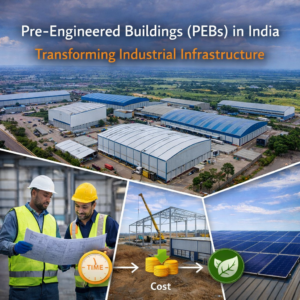
If you look at what’s happening across India in 2026, one thing is very clear — PEB Buildings in India 2026 are playing a major role in the country’s fast-moving industrial development.
Warehouses are coming up near highways. At the same time, manufacturing units are expanding. Logistics hubs are growing around freight corridors. As a result, every month, new industrial projects are announced.
But here’s the real question — how are these projects getting completed so quickly?
The answer in most cases is PEB Buildings in India 2026, also known as Pre-Engineered Buildings (PEB).
PEB structures are no longer just an “alternative” to traditional construction. In many industrial projects today, they are the first choice.
What Exactly Is a PEB Building?
In simple words, a Pre-Engineered Building is a steel structure that is designed in detail before it reaches the site.
The components are:
- Engineered using specialized software
- Manufactured inside factories
- Delivered to the site in ready-to-assemble parts
- Installed quickly using planned erection methods
Unlike traditional RCC buildings, where most of the work happens on-site, PEB construction shifts major work to the factory level. That alone changes everything — speed, quality control, and efficiency.
You’ll mostly see PEB used in:
- Warehouses
- Industrial sheds
- Manufacturing plants
- Cold storage facilities
- Logistics parks
- And now even in large turnkey industrial projects.
Why PEB Buildings in India 2026 Are Growing So Fast
1. Speed Matters More Than Ever
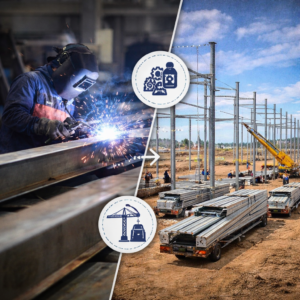
In industrial projects, delays are expensive.
Every extra month of construction means delayed production, delayed storage operations, and delayed revenue.
With PEB construction, foundation work and structure fabrication happen at the same time. Because of this, project timelines reduce significantly.
In fact, many projects get completed weeks — sometimes months — earlier.
For business owners, that time saving is critical.
2. Better Control Over Budget
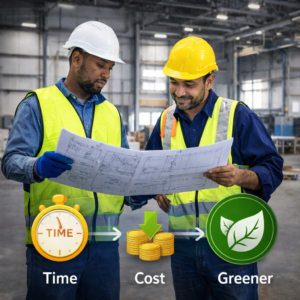
However, one common issue in traditional construction is cost variation.
Material wastage, labor delays, design changes — all of these impact the final cost.
With PEB, the structure is engineered precisely. Steel quantities are optimized. Fabrication is controlled. On-site surprises are reduced.
Therefore, budgeting becomes more predictable.
For industrial investors, predictability is just as important as cost savings.
3. Open, Flexible Spaces
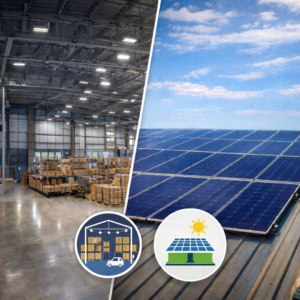
Modern warehouses and factories need space — and not just space, but usable space.
Heavy machinery, storage racks, forklift movement, automated systems — all require clear areas without internal columns.
As a result, PEB buildings are designed to provide wide clear spans. That means fewer obstructions and more flexibility inside the building.
Moreover, if operations expand later, modifications are easier compared to RCC structures.
4. Sustainability Is Now a Real Factor
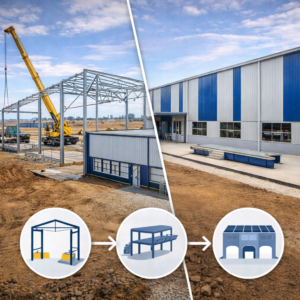
Earlier, sustainability was a bonus.
In 2026, it’s becoming a requirement.
PEB structures support green practices because:
- Steel is recyclable
- Construction waste is lower
- Roofing can support solar panels
- Insulated panels improve energy efficiency
With industries under pressure to reduce carbon footprint, PEB becomes a practical solution — not just an environmental statement.
5. Easy Expansion in the Future
Industries grow. Production increases. Storage requirements change.
One of the strongest advantages of PEB buildings is that they can be extended without major reconstruction.
Additional bays, mezzanine floors, and height adjustments can be planned in the initial design itself.
That flexibility saves long-term cost and effort.
How PEB Buildings in India 2026 Supports India’s Industrial Push
Government initiatives like Make in India (https://www.makeinindia.com) and PM Gati Shakti (https://www.gatishakti.gov.in) are driving infrastructure development at a large scale.
New industrial corridors, freight routes, and logistics networks are being developed across the country.
To support this pace, construction must be:
- Faster
- Scalable
- Structurally reliable
- Economically feasible
PEB fits naturally into this ecosystem.
It allows industries to build quickly without compromising on strength or performance.
Industries Using PEB in 2026
Today, PEB structures are being used in:
- Manufacturing plants
- Automobile facilities
- FMCG warehouses
- E-commerce fulfillment centers
- Pharmaceutical units
- Cold storage projects
- Textile and food processing industries
From mid-sized units to massive industrial parks — PEB has become a common choice
Where Is This Heading?
If current trends continue, steel-based industrial structures will dominate the next decade of construction in India.
The shift from RCC to engineered steel buildings is not just about speed anymore. It’s about efficiency, lifecycle value, and adaptability.
The construction industry is evolving — and PEB is part of that evolution.
Why Panjetani Buildwell For PEB Buildings In India?
In industrial construction, execution matters more than promises.
At Panjetani Buildwell, the focus is not just on building a structure — but on delivering a complete solution that works for the client’s operations.
From design planning to fabrication and final erection, projects are handled with attention to timelines and structural performance.
What clients appreciate most:
- Complete turnkey approach
- Customized industrial solutions
- Precision fabrication
- Reliable execution
- Practical, scalable designs
As industrial infrastructure continues to grow in India, choosing the right construction partner becomes as important as choosing the right location.
If you’re planning an industrial project in 2026 — whether it’s a warehouse, factory, or logistics hub — working with an experienced PEB specialist makes a measurable difference.
🌐 www.panjetanibuildwell.com
📞 9205596515 | 9205951100
✉️ inquiry@panjetanibuildwell.co.in


